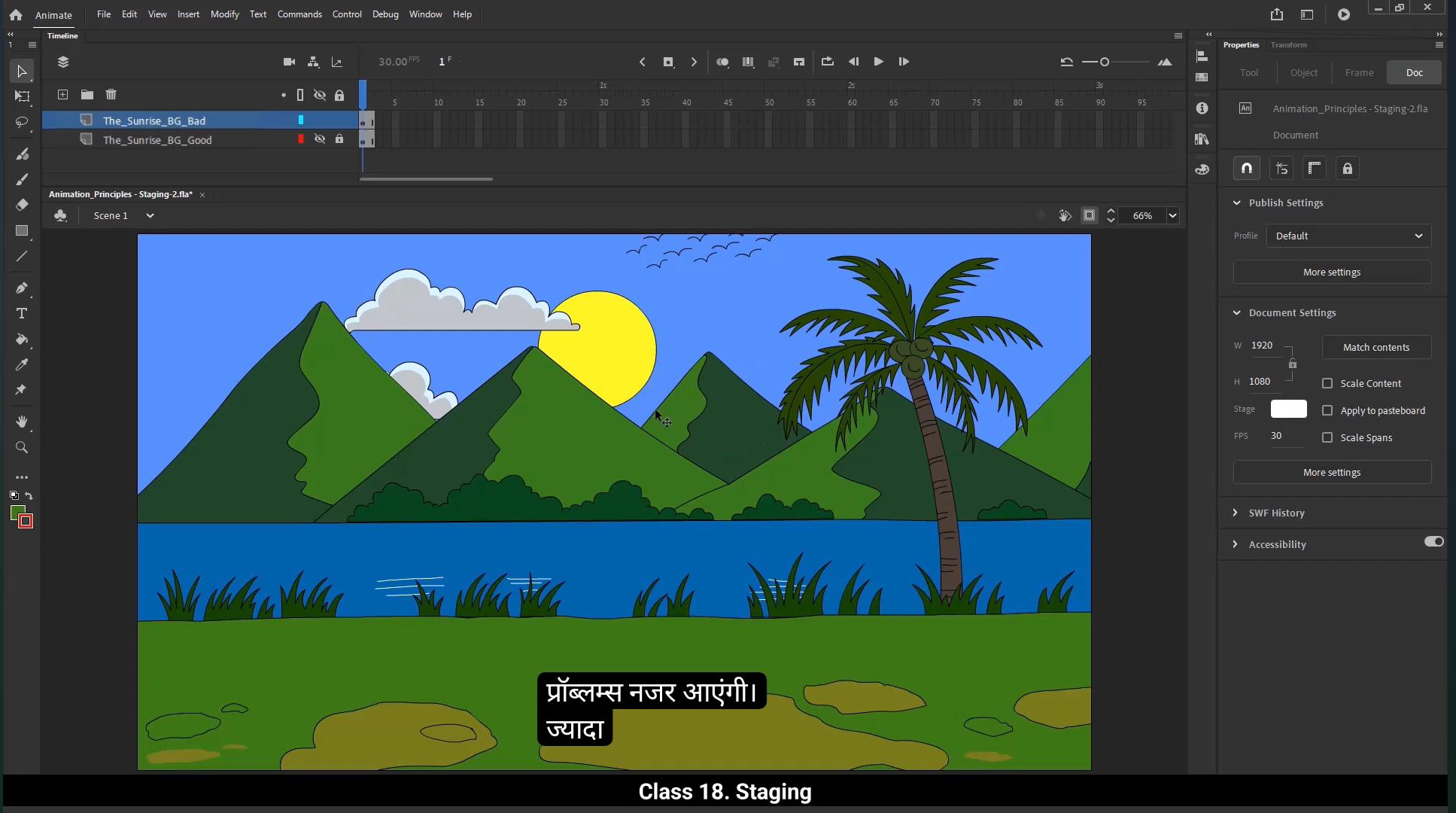
Hello students, in this video we will continue learning about animation principles, focusing on the next important principle, staging, also known as composition. To explain this concept, I've used the background animation image from our previous lesson.I've prepared 2 layers for comparison, bad and good.Let's start with the original background in the good layer. Here, all the elements, the clouds, sun, birds, coconut tree, mountains, river ground and grass bushes are thoughtfully arranged, creating a well organized and visually appealing composition. However, if you look at the bad layer, you'll notice several issues. There's too much empty space, the ground takes up an excessive area, and the.Of the ground is distorted, Additionally, the clouds, mountains, and sun are overlapping, while the birds are awkwardly positioned and appear cut off. This arrangement does not look appealing or professional. It resembles a child's drawing. For better understanding, let me guide you further. Here is the good layer our original composition in this version.Everything is perfectly organized, neat and visually balanced.This is an example of good staging composition where all elements in the scene are well arranged and create a polished output.Remember, your staging should always look clean and professional, not chaotic or poorly organized.Here the perspective is lost, there are overlapping elements and the empty spaces make the composition unappealing.This is where staging plays a crucial role. Staging ensures that all elements on the screen are thoughtfully and neatly arranged to guide the viewers focus effectively.Let me illustrate this further with another example, a football kicking animation. In this example, the camera first focuses on the football, clearly establishing it as the subject. Let's play the animation for a better understanding. As the animation progresses, the camera pulls back the character enters the frame, and then kicks the ball.This sequence is also an example of good composition because the order in which the elements appear on the screen is intentional and meaningful. It helps convey the action clearly and keeps the viewer engaged. Staging is not just about setting a perspective, it also involves determining the order in which characters and elements appear on the screen.For example, in the football kicking animation, I've arranged the sequence as follows. The football appears on the screen first for the initial frames, followed by the character entering, the goalkeeper appearing, and finally the player kicking the ball. This progression helps maintain clarity and focus. Now let's look at an example of bad staging.In this version, everything is visible on the screen from the start, and the camera shifts focus erratically from the character to the scene and back again. This results in unnecessary movement, which is distracting and takes attention away from the main action. The sequence lacks the clear progression required for effective storytelling, making it a poor example of staging.In this animation, the focus on the main action is lost. The key moments, such as the player kicking the ball and the jump are not emphasized. Instead, the composition relies heavily on unnecessary zoom-ins and zoom outs, which detract from the clarity and impact of the scene.
This makes it an example of poor staging. In contrast, in the first example, the football appears on the screen first, establishing it as the subject.The character steps in and the camera pulls back to provide context. Then character kicks the ball. This sequence maintains focus on the main action and highlights important details, making the scene more engaging and professional. And that's it for today's lesson on staging, one of the essential principles of animation.Remember, a well staged scene can significantly enhance the storytelling and overall impact of your work. I.I hope you found this tutorial helpful. Thank you. See you in the next video.
हैलो स्टूडेंट्स, इस वीडियो में हम एनीमेशन प्रिंसिपल्स की पढ़ाई को आगे बढ़ाते हुए अगले इम्पॉर्टेन्ट प्रिंसिपल पर फोकस करेंगे – स्टेजिंग, जिसे कम्पोज़िशन भी कहा जाता है। इस कॉन्सेप्ट को समझाने के लिए मैंने पिछली क्लास से बैकग्राउंड एनीमेशन इमेज का इस्तेमाल किया है। मैंने कम्पैरिजन के लिए 2 लेयर्स तैयार की हैं – बैड और गुड।
चलिए गुड लेयर से शुरू करते हैं। यहाँ सभी एलिमेंट्स – क्लाउड्स, सन, बर्ड्स, कोकोनट ट्री, माउंटेन्स, रिवर ग्राउंड और ग्रास बुशेस – अच्छे से अरेंज किए गए हैं। रिज़ल्ट है एक वेल ऑर्गनाइज़्ड और विज़ुअली अपीलिंग कम्पोज़िशन। लेकिन जब आप बैड लेयर देखेंगे, तो आपको कई प्रॉब्लम्स नज़र आएँगी। ज़्यादा खाली जगह है, ग्राउंड का एरिया बहुत बड़ा है और उसका शेप डिस्टॉर्टेड है। इसके अलावा, क्लाउड्स, माउंटेन्स और सन आपस में ओवरलैप हो रहे हैं, बर्ड्स अजीब-सी पोज़िशन में रखे गए हैं और कटे-कटे से लगते हैं। ये अरेंजमेंट बिल्कुल अपीलिंग या प्रोफेशनल नहीं लगता, बल्कि बच्चों की ड्रॉइंग जैसा लगता है।
बेहतर समझ के लिए गुड लेयर पर वापस चलते हैं। इस वर्ज़न में सबकुछ परफेक्टली ऑर्गनाइज़्ड है, क्लीन और विज़ुअली बैलेंस्ड है। ये एक गुड स्टेजिंग कम्पोज़िशन का उदाहरण है, जहाँ सारे एलिमेंट्स अच्छे से अरेंज होकर पॉलिश्ड आउटपुट क्रिएट करते हैं। याद रखें, आपकी स्टेजिंग हमेशा क्लीन और प्रोफेशनल दिखनी चाहिए, न कि कैओटिक या खराब तरीके से ऑर्गनाइज़्ड।
बैड वर्ज़न में परस्पेक्टिव लॉस्ट है, एलिमेंट्स ओवरलैप हो रहे हैं और खाली जगहें कम्पोज़िशन को अनअपीलिंग बना रही हैं। यही जगह है जहाँ स्टेजिंग का क्रूशियल रोल आता है। स्टेजिंग सुनिश्चित करती है कि स्क्रीन पर सभी एलिमेंट्स सोच-समझकर और साफ-सुथरे तरीके से अरेंज हों, ताकि व्यूअर का फोकस इफेक्टिवली गाइड हो।
अब एक और उदाहरण लेते हैं – फुटबॉल किकिंग एनीमेशन। इस उदाहरण में कैमरा सबसे पहले फुटबॉल पर फोकस करता है, जिससे साफ पता चलता है कि ये सब्जेक्ट है। जब एनीमेशन आगे बढ़ता है, कैमरा पुल बैक करता है, कैरेक्टर फ्रेम में एंटर करता है और फिर बॉल को किक करता है। ये सीक्वेंस भी गुड कम्पोज़िशन का उदाहरण है, क्योंकि स्क्रीन पर एलिमेंट्स अपीयर होने का ऑर्डर इंटेंशनल और मीनिंगफुल है। इससे एक्शन क्लियर रहता है और व्यूअर इंगेज्ड रहता है।
स्टेजिंग सिर्फ परस्पेक्टिव सेट करने तक सीमित नहीं है, ये ये भी तय करती है कि स्क्रीन पर कैरेक्टर्स और एलिमेंट्स किस ऑर्डर में अपीयर होंगे। जैसे फुटबॉल एनीमेशन में – पहले फुटबॉल स्क्रीन पर आती है, फिर कैरेक्टर एंटर करता है, उसके बाद गोलकीपर दिखता है और आखिर में प्लेयर बॉल को किक करता है। ये प्रोग्रेशन क्लैरिटी और फोकस बनाए रखता है।
अब बैड स्टेजिंग का वर्ज़न देखते हैं। इसमें शुरुआत से ही सबकुछ स्क्रीन पर विज़िबल है और कैमरा बार-बार फोकस बदलता है – कभी कैरेक्टर पर, कभी सीन पर। ये अननेसेसरी मूवमेंट डिस्ट्रैक्टिंग है और मेन एक्शन से ध्यान हटा देता है। सीक्वेंस में क्लियर प्रोग्रेशन की कमी है, जिससे स्टोरीटेलिंग इफेक्टिव नहीं रहती।
इस एनीमेशन में मेन एक्शन पर फोकस खो गया है। की मोमेंट्स जैसे – प्लेयर का बॉल को किक करना और जंप – हाइलाइट नहीं होते। बल्कि कम्पोज़िशन अननेसेसरी ज़ूम-इन और ज़ूम-आउट पर निर्भर करता है, जो क्लैरिटी और इम्पैक्ट घटा देता है। यही कारण है कि ये पुअर स्टेजिंग का उदाहरण है।
इसके विपरीत, पहले उदाहरण में फुटबॉल सबसे पहले स्क्रीन पर आती है, सब्जेक्ट सेट करती है। फिर कैरेक्टर एंटर करता है और कैमरा कॉन्टेक्स्ट देने के लिए पुल बैक करता है। इसके बाद कैरेक्टर बॉल को किक करता है। ये सीक्वेंस मेन एक्शन पर फोकस बनाए रखता है और इम्पॉर्टेन्ट डीटेल्स को हाइलाइट करता है, जिससे सीन ज़्यादा इंगेजिंग और प्रोफेशनल बनता है।
और बस यही था आज का लेसन स्टेजिंग पर, जो एनीमेशन के एसेंशियल प्रिंसिपल्स में से एक है। याद रखें, एक अच्छी तरह से स्टेज की गई सीन आपकी स्टोरीटेलिंग और ओवरऑल इम्पैक्ट को काफी बढ़ा सकती है। उम्मीद है ये ट्यूटोरियल आपके लिए हेल्पफुल रहा होगा। थैंक यू, मिलते हैं अगले वीडियो में।